Write-up by: Earl Jerald Fadriquela Cansino Φ2024 | Edited by: Al Christian Navarro Mabute Φ2025
There is a certain comfort that comes with mastery. After decades of practice, expertise becomes instinctive, routines become familiar, and the difficult work of proving oneself gradually gives way to confidence. Most people spend their lives seeking that point of arrival.
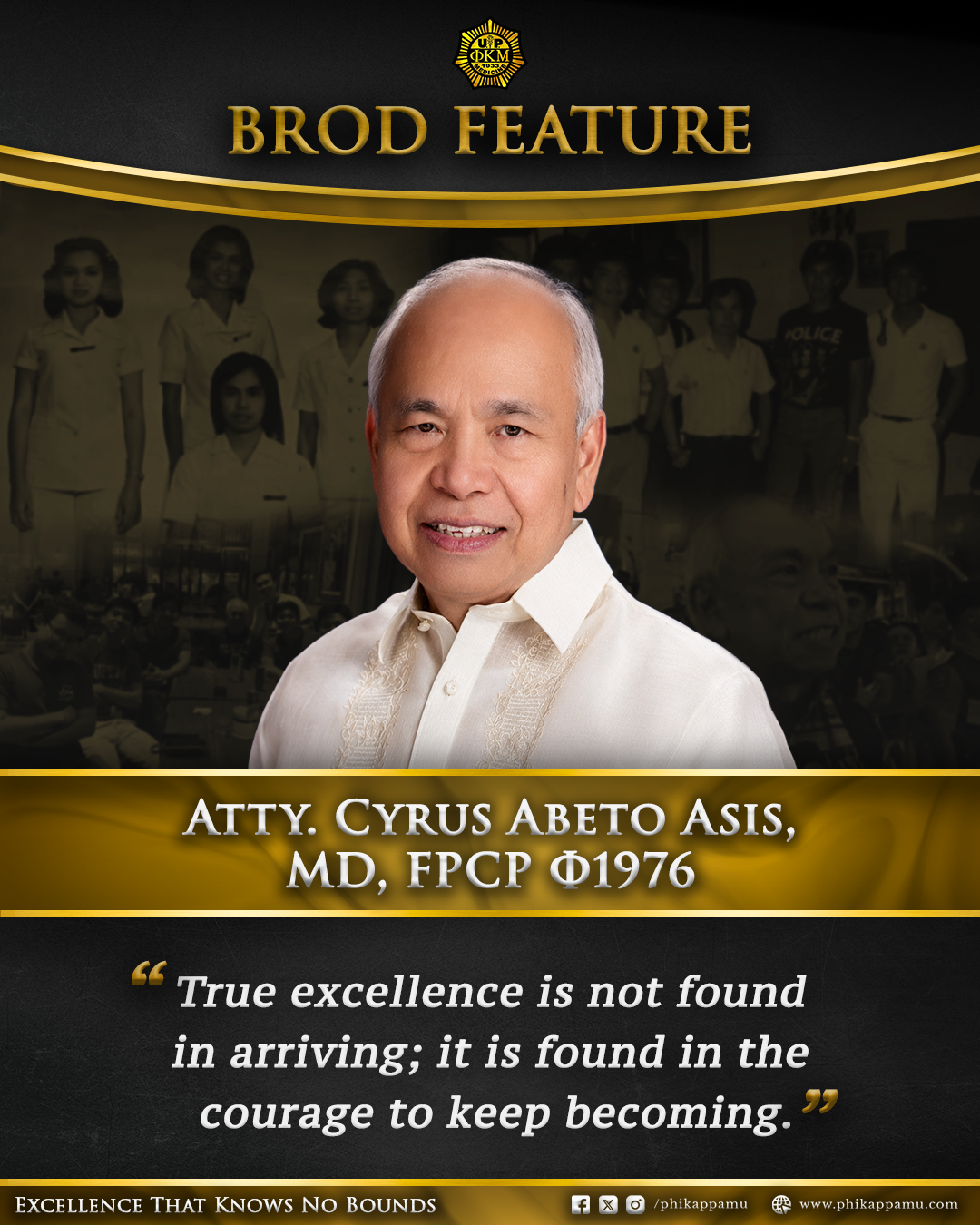
Brod Cyrus Abeto Asis Φ1976 chose to walk away from it.
Long after establishing himself as a respected cardiologist in the Davao region, he stepped into a law school classroom. He exchanged the authority of experience for the uncertainty of beginning again. In a world that celebrates achievement as a finish line, his journey tells a different story: that excellence is not found in reaching the summit, but in having the courage to continue climbing. For him, professional success was never an endpoint. It was an invitation to keep learning, keep serving, and keep becoming.

Even today, his understanding of a “good day” reflects this philosophy. Rather than measuring success through accolades or personal achievement, he frames it through the lens of service. A good day means running the clinic smoothly, effectively managing difficult cases, and ensuring that patients receive the care they need. It means navigating the unpredictable demands of medicine while striving to minimize morbidity and mortality. Excellence, in this sense, is not found in extraordinary moments but in the consistency of showing up each day prepared to serve others with competence and compassion.

Photo credits from SunStar Davao (2024) https://www.sunstar.com.ph/davao/68-yr-old-doctor-hurdles-bar-exams
Medicine taught him how to save lives; experience taught him that service often extends beyond the clinic. Influenced by his father’s own legal aspirations and shaped by years of confronting the legal dimensions of healthcare, Brod Cyrus found himself drawn toward law. When the pandemic unexpectedly created space for reflection and growth, he embraced the opportunity. For him, studying law was never about starting over; it was about continuing the lifelong work of becoming.
Choosing to enter law school after decades in medicine required something more difficult than intellectual capability. It demanded humility. It required relinquishing the confidence that comes from expertise and embracing the vulnerability of becoming a student once again.
Initially, Brod Cyrus approached legal education with modest expectations. He imagined himself simply attending lectures, satisfying a long-held curiosity about the legal profession. However, it quickly became apparent that law school demanded full commitment. There were cases to digest, doctrines to memorize, recitations to survive, and entirely new ways of thinking to develop. The transition forced him to confront a profound truth: excellence in one domain does not exempt anyone from the discipline required to excel in another.
The challenges were not merely academic. During law school, he continued practicing medicine actively. His days began with outpatient consultations from morning until noon, six days a week. Afternoons became dedicated study periods, followed by evening classes. Often, after classes concluded, he returned to his books before preparing to repeat the cycle the next day. The demands of medicine did not pause simply because he had become a law student. Patients still required care. Emergencies still occurred. Difficult cases still demanded his attention. There were days when the responsibilities of both professions collided. Toxic patients, hospital referrals, and the emotional burden of clinical practice frequently competed with examinations, readings, and class participation. Yet amid these competing obligations, he persisted. The pursuit of excellence, he discovered, was not dependent upon ideal circumstances. Rather, it was sustained through disciplined commitment despite imperfect conditions.

Central to this discipline was perseverance. Throughout his reflections on both medicine and law, Brod Cyrus consistently returned to the importance of grit over brilliance. While intelligence provides a foundation, perseverance determines whether potential becomes achievement. He firmly believes that perseverance is both innate and cultivated, a habit strengthened through repeated choices to continue despite difficulty.
Long before law school tested his resolve, medicine and fraternity had already taught Brod Cyrus that perseverance often matters more than brilliance. Both demanded resilience, discipline, and the commitment to continue despite uncertainty and setbacks. Thus, when he failed a subject during his first year of law school, and faced disappointment again after a removal examination, he viewed these experiences not as signs of inadequacy, but as part of the rigorous process of growth. Failure, after all, was not the opposite of excellence; it was often one of its teachers.
“Tomorrow is another day,” he often reminded himself. It was a mindset shaped by decades in medicine, strengthened through brotherhood, and reaffirmed during law school. To Brod Cyrus, excellence was never synonymous with perfection. Instead, it required resilience: the ability to learn from setbacks without allowing them to define one’s identity, and the discipline to persist even when progress appeared uncertain.
Yet he is quick to acknowledge that perseverance rarely exists in isolation. Behind every individual achievement stands a community of support. Throughout his legal journey, his family played an indispensable role, particularly his wife, who helped an “analog man” navigate an increasingly digital world. From assisting with online research to gathering legal forms and resources, her support transformed what seemed like an individual pursuit into a shared endeavor. When he eventually passed the bar, she jokingly remarked that they had both passed.
In many ways, this reflects another truth about excellence: it flourishes within communities of support. Families encourage, mentors direct, and brotherhood creates enduring networks rooted in shared values and mutual upliftment. These relationships remind us that while achievement may bear an individual’s name, perseverance is often sustained by those who believe in our capacity to continue. The courage to begin again may be personal, but the strength to endure is frequently found in the people who choose to walk alongside us.
Perhaps the most compelling aspect of Brod Cyrus’ journey is the way it challenges prevailing assumptions about age, professional identity, and the pursuit of new aspirations. Modern society often suggests that there are prescribed timelines for achievement: careers should be established early, expertise should narrow over time, and significant reinvention becomes increasingly impractical with age. His story offers a powerful alternative narrative. “Experience was never a barrier to learning,” he said. Instead, it became an advantage. Years of clinical practice had cultivated analytical thinking, emotional resilience, discipline, and perspective. Experiences with patients, healthcare systems, and institutional leadership provided a deeper understanding of human complexity that enriched his legal education. Rather than diminishing his capacity to learn, maturity clarified his motivations and strengthened his resolve.

When asked what advice he would offer to individuals considering new pursuits later in life, his response emphasizes decisiveness and commitment. Once a person chooses a path, he believes it must be pursued wholeheartedly. Success in law, or any meaningful endeavor, requires more than interest. It requires conviction. Doubt may be natural, but commitment must ultimately prevail. At the same time, he acknowledges that fear accompanies all significant undertakings. Fear of failure is not evidence of weakness. In fact, he argues that such fear is entirely normal. It reminds us of what matters. It motivates preparation, humility, and perseverance. Courage, therefore, is not the absence of fear but the willingness to continue despite it.
At the heart of Brod Cyrus’ philosophy is the belief that learning remains possible at every stage of life. More often than not, the limits we encounter are not imposed by time, but by the assumption that growth is no longer meant for us. His message to others is simple: never let who you are today prevent you from becoming who you can still be. In a world that often equates success with arrival, Brod Cyrus offers a different perspective. Excellence is not found in reaching a final destination, but in choosing, time and again, to keep moving forward. To continue learning. To remain open to new callings that deepen our capacity to contribute.
Perhaps that is the truest measure of excellence: not the titles we accumulate or the milestones we achieve, but the courage to keep becoming.